Showing posts with label Amélie Nothomb. Show all posts

Saturday, November 1, 2014

Bookish Halloween Costume

If you know me by now, you would know I am crazy passionate about author Amélie Nothomb. When I was invited to the Halloween party organized by my friends from the Lebanon Book Club around the themes of books, I knew I finally had a chance to walk her walk and talk her talk. In addition, I enjoyed designing the most important accessory in Amélie Nothomb's clothing; her hat.


Now Halloween themed costume parties are in my opinion the most successful ones. Combine that with books and you get one hell of a night! Thanks Simon and Katia for organizing this.


Check out the result and let me know what you think. My friends tend to think that I am starting to look like her in real life because I am that crazy about her. This is by far the best compliment I ever heard.
Other than that, here are some of the costumes that were worn on that night, hope this will inspire you for your next Halloween party.
Schehrezade, The last of the Mohicans, Samurai, The general from Anna Karenina, little red riding hood, a dress code in red and black in reference to "Le Rouge et le Noir" by Stendhal, The rabbit from Alice in Wonderland, Jane Austen or a Victorian Woman, A reader (no costume) etc.

Happy Halloween!


Cheers


With a reader, signing his book

With the latest Novel, Pétronille 

Just another one of those "Pause for the Camera moments"


Friday, September 26, 2014

My Epistolar Traces

If you know me, or have read the blog, you would know by now my obsession about this Belgian author who answers to the name of "Amélie Nothomb".
(But please feel free to click here if you have no idea what I am talking about)


The other day, I stumbled on a letter I wrote to lady Nothomb on the 17th of January, 2010.  I couldn't help but read it of course, and it plunged me in the same emotional state that I was in when I first wrote those words to her. I also remembered how magical writing letters to each other is, and how very few people in Lebanon still do it. Most importantly, I realized all of sudden that aside from my reviews on the blog, I have almost no writings of my own, except for the letters I exchange with my friends and loved ones.


I have decided to share with you this personal letter (written in French) in an attempt to preserve the few witnesses of my pen traces and to urge you to write to each others as if mailing was the only means of communication known in your time. The world's greatest writers, poets and even scientists and rulers did it so why wouldn't you? Check it out yourself if you don't believe me by following this link.


And now for my letter:


"                                                                                                                                         Le 17-01-2010


Chère Amélie,
J'aimerai sincèrement saluer votre courage et vous remercier d'être venue au Liban quelques mois après une guerre très marquée encore dans nos esprits à tous. Je vous remercie également de m’avoir retourné la photo ; j’y tenais vraiment beaucoup.


Le courrier comme vous l’avez indiqué est une jolie façon de se rencontrer. En tant que lectrice fidèle, je me considère très chanceuse de pouvoir vous écrire et vous lire en privé ; vous mon auteure préférée dont les œuvres m’ont transformé en lectrice. J’ai l’impression de me répéter encore dans cette lettre mais je ne peux pas m’empêcher de vous déclarer mon estime et admiration à chaque occasion qui s’offre. Autant c’est un plaisir de vous écrire, autant c’était un plaisir d’avoir lu vos mots doux. J’ai été très touchée par votre lettre et surprise que vous vous intéressiez à moi, à savoir ce que je fais en ce moment. Et bien, je galère un peu comme tout le monde pour commencer une thèse mais je suis optimiste et je travaille beaucoup afin de mener à terme ce projet, donc tout devrait bientôt s’arranger.

Sinon, j’ai fait la connaissance de plusieurs personnes admirables sur le forum actif qui vous est consacré, et de fortes amitiés sont nées entre nous : ma vie est plus joyeuse depuis.


Enfin chère Amélie, je tenais à vous dire que je vous écrirai régulièrement une (peut-être deux) lettre(s) par an tant que vous le permettez. Nous sommes très nombreux à vous écrire et je ne souhaite vraiment pas vous épuiser ni abuser de votre gentillesse. Même si je ne vous écrirai pas souvent, sachez bien que je penserai souvent à vous : vous faites vraiment partie des personnes les plus importantes, influeçantes et présentes dans ma vie.
Bonne année et à l’année prochaine

Votre disciple Isabelle

P.S. Eh oui je dis bien disciple, quelques amis et moi étions vraiment surpris d’apprendre que nous étions des disciples, voir même une secte !!! Mais nous nous sommes tous mis d’accord : quand vous (que votre nom soit loué) auriez décidé de la fin de notre monde, nous nous jetterons tous dans une mare de carpes – ou si nécessaire dans un aquarium rempli de poissons rouges.


P.S.2 Mes tantes aux États-Unis à qui j’ai offert « Stupeur et tremblements » et « Ni d’Ève ni d’Adam »  pour Noël vous saluent beaucoup aussi. »  


If you're reading this post, I would really love to have more interaction with you. So let me know if you have ever written to authors you like or if you consider it. It would also be great to discover what you think of epistolary relationships.

Cheers


Saturday, March 1, 2014

La Nostalgie Heureuse by Amélie Nothomb - Summary

Key words: Autobiography, Travel, Japan, Nostalgia

Introduction: "La Nostaglie Heureuse" is an autobiographical story that traces the last trip of Amélie Nothomb to Japan. This country means a lot to this author who was born in Kobe in a family of a diplomat. Amélie was raised by a Japanese nanny "Nishio San" to whom she was and still is very attached. She was snatched from the country and separated from Nishio San at the age of three years, but she returned to it later for work when she was 20 years old and this is when she met the nicest boy in the world that she's ever known as she claims; a boy named "Rinri". He proposes to her, she accepts and then leaves back to Belgium with the intention to leave Rinri and he only discovers the whole thing after she has escaped. Later, in 2000 she publishes "Ni d’Ève ni d’Adam" in which she talks about the story of their engagement.


Tout ce que l'on aime devient une fiction.


Summary: Sixteen years have passed since Nohomb's last visit to Japan. In 2012 a team of France 5 proposes to her to go on a trip back to this country to film a documentary.  Amélie Nothomb accepts immediately. This documentary is the excuse she needed to return back to this loved country for she admits she was incapable to do so before « La pulsion de néant, … cherche à anéantir mes désirs les plus vrais. » « C’est la même pulsion de néant, j’en suis sûre, qui m’a empêchée de retourner au Japon pendant ces seize interminables années. » Once the trip is confirmed, she tries to contact Rinri to reconnect with him. Rinri is surprised but agrees to see her and we discover that he has become one of her most loyal readers. Upon her arrival to Kobe, she is sadly surprised by all the changes throughout the city. And to top it all, she discovers that her childhood home was destroyed by the earthquake. So for the rest of the trip she decides to look  only for the things that have survived and focus on them. Then comes the long awaited moment of her reunion with her nanny. It is sad for her to see how much Nishio San has aged, and to learn that her own children and grandchildren do not visit her. She tries to comfort her by telling her that she is her daughter too, and melts into tears while the two women embrace. A moment later, in the car, she discovers that the whole team shooting the documentary is in tears as well.

Amélie who thought that « Les retrouvailles sont des phénomènes si complexes qu’on ne devrait les effectuer qu’après un long apprentissage ou bien tout simplement les interdire. » now declares that « À présent je pense que les séparations devraient l’être également. »

During the rest of the documentary, Amélie visits her former kindergarten the "Yôchien", which seems to be the only place to have survived the earthquake. She finds a class picture that overwhelms her with happiness for it is the proof she needed to see to make sure that she did not just dream or imagine her childhood memories but that instead she literally lived in these places and didn't invent anything. Amélie heads then to what became the modern city Kyoto and also to Fukushima which was hit by a devastating earthquake a year ago. Tokyo is her last destination, and she feels so good in this city that her answer to the question asked by a reporter on the phone « Quand rentrez-vous en France ? » was « Jamais. » « Je suis une aspirine effervescente qui se dissout dans Tokyo.». She ends up meeting Rinri, revisiting the same places they had known together, talking with him of the past, present and eventually apologizing to him « Rinri pardonne-moi j’étais folle ». Deep inside however, she is now convinced that she does not regret leaving him because with him, she always had a feeling of embarrassment and discomfort and that she still does. For a moment, one is tempted to believe that this journey would end with a lot of nostalgia and melancholy but when the airplane flies over the Everest mountains Amélie is struck by the beauty she sees and ends up swearing that she'd never have sorrow or melancholy anymore « Jure-toi, Amélie, que tu n’auras plus jamais de chagrin ni même de mélancolie ; qui a frôlé l’Everest n’en a pas le droit. Le maximum que je t’autorise, désormais, c’est la nostalgie heureuse».


Tuesday, September 3, 2013

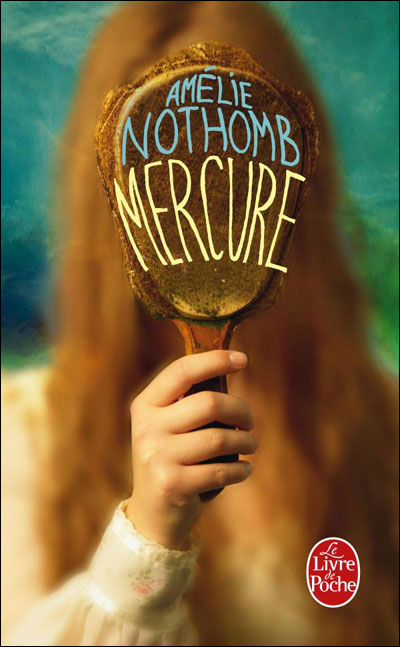
Mercure - Amélie Nothomb First vs Second Ending

Amélie Nothomb is my syndrome and my cure and the month of August is the month of Amélie Nothomb by excellence. Why? One could ask. The answer is simply because Nothomb publishes a new book every year on this month. The waiting period before the new book's release often brings back old memories and new discussions, and this is how I was lucky to meet two Nothombophiles just like me (Ok maybe not exactly like me, but still, the point is that they love Nothomb's books :D).

The funny thing was that both Boudi and Tonie's favorite book by Nothomb was "Mercure". When I read this book the first time, it did not mark me and I couldn't understand why people even like it, it didn't seem original to me. It wasn't until I read a professional review of this book that I completely changed my mind about it. This is literally how and when I learned to read between the lines and the importance of paying attention to the literary, psychological  and social value of a book, not only its plot and style. The review is written in French by a philosophy and letters PhD holder (Université catholique de Louvain) with whom I have discussed this book. To me the review is perfect in every sense of the term but you can check by yourselves at this link: 


"Il nous est ordonné d'être jeunes et belles et, dès qu’il s’agit de tomber amoureuses, il nous est conseillé de ne pas tenir compte de ce genre de détail"
 

Briefly, the story is about a very pretty girl who is tricked into believing that her face has been mutilated so badly that she doesn't even look human anymore. Of course the old man that tricked her keeps her on an island, isolated from the world. He looks after her but he also has sex with her. The girl likes the old man as a father although he is almost as old as her grandfather. She hates however the sexual acts and maybe even more because she likes his paternal side. The book is a modified version of the Beauty and the beast or Esmeralda and quasimodo but with the hero being much older than the girl. The themes in this book include among others beauty, incest, age difference etc. One day the girl gets sick and the old man brings a nurse to look after her. The nurse discovers the truth and decides to save the girl. Nothing new? Nothing creative here one could say right? Wrong! Amélie Nothomb ends the book in two different ways:
Ending number 1: The nurse saves the girl, the girl learns also that she is pretty and they both spend their lives cruising happily ever after together as friends (or more, the author keeps it unclear).
Ending number 2: The nurse saves the girl from the old man only to take his place. The girl still thinks she is mutilated and she is not freed, however she seems to enjoy her captivity and life with her new aggressor: the beloved nurse. Beloved yes, the girl did not like the old man but she likes the nurse, in fact the two clicked ever since they met.

Automatically, the nurse's behavior in each ending makes her
1- A hero who is trying to do something good for the girl.
2- A selfish person who is trying to do something good for herself.
Amélie Nothomb wrote two endings because she couldn't choose one. I thought that she left it for the readers to choose the ending they preferred and I happen to have preferred the second one for the following reasons:

The main reason why I liked it is because whenever someone gives me two choices one that is realistic and one that is a bit exotic, I go for the exotic one. As I always say, if I want to read about real stuff I'd pick up a newspaper and not a book! However, even though I hate realistic events, I found that the second ending is the most realistic one, but not in a dull way. The second ending exposes the very true nature of human beings and that is: selfishness (For more insight on this matter refer to "the selfish gene" by Richard Dawkins). 

Also, heroism in my opinion, does not exist and altruism is nothing more than an invention or an illusion. The only real emotion that is innate to mankind is selfishness. It seems crazy said like that but let's take some examples: in a couple, you would say that a person that always tries to make the other happy is a proof that altruism exists. But a person in a couple unconsciously is trying to make him/herself happy because when the other is happy, the happiness returns back to him/her. Newton's third law seems to agree with this explanation for it states that "for every action, an equal and opposite reaction will take place" meaning that you receive what you give! This sacred Newton, who knew he was that tough?! Another example and I will stop to avoid too much digression: parents, often mothers are seen as the most powerful examples of sacrifice and altruism for they do anything for their children. THEIR children! yes, their half selves, their own genes! We are selfish, end of story. 

Another reason why I preferred the second ending is because it is the scenario of instinct overthrowing reason. Only something very powerful and overwhelming can lead to such case and the feeling after unleashing the instincts would be as powerful and overwhelming. In our lives, at least once, we all have given in to our instinct. If we remember that one time, and the powerful emotions that took over us when we unleashed our instincts, we should be able to better understand the power and beauty of the second ending.

Finally, I personally liked the second ending because it would have personally made me much more happier than the first, if I were to be the nurse. I mean who wouldn't want to have control, all the pleasure and no repercussions?

Now that being said, I think that we can prefer one conclusion or the other but at the end, Nothomb was right, both are necessary for the book. Nothing makes "Mercure" the great book that is is than having these two endings and giving us the freedom of choice. In both cases the girl is happy which is to say happiness can be achieved by different paths. 

P.S. If you have read the book, don't hesitate to let me know which ending you prefer and why?




Monday, March 25, 2013

My syndrome

I have tried to hide it for as long as I could but I just cannot fight it anymore. My name is Izzy and I am Améliesque! Stay calm, bare with me the few digressions, keep reading, and you'll understand my syndrom.
 
My symptoms started 4 years ago when I borrowed a movie at the Institut Français (Centre Culturel Français back then, mission previously etc. And by the way, does anyone know why the name keeps on changing?) Anyways, this movie, "Stupeur et tremblements" by Alain Corneau (still can't believe he's gone :( and just in case you're interested check his last movie "Crime d'amour" one of the best works ever) and starring the more than BRILLIANT Sylvie Testud (I love you!) litterally changed my life.

The plot was captivating and the turn of events was such an original one. This movie was based on Amélie Nothomb's novel by the same name which also won the "Grand Prix de l'Académie Française". Curiosity lead me to check the author's books and before I realised it, this innocent curiosity developped into addiction.
What do I mean by addiction? Nothing much. I just read her 21 books, I write to her, I've been quoted in one of the books about her and recently for my birthday this was my cake:
 

Without my friend JM this cake would have never seen the day, thank you again so much!
 
This blog will have a whole section about this author and her books. She deserves a blog at least, but I will try to give her justice as much as I can on this page. I believe Amélie is the drug no one can resist. Sooner or later you will all become "Améliesque" like me and life would never be the same again.